Wondering if you really need a car in WaterSound Beach? If you picture quick beach trips, easy morning coffee runs, and relaxed evenings on shaded paths, the answer is often yes for daily life, but not for every trip. In Watersound and the surrounding WaterSound area, the community layout supports walking, biking, and other low-speed ways to move around, while still leaving some limits on a fully car-free routine. Let’s dive in.
Walkability in WaterSound Beach
WaterSound is built around a pedestrian-oriented design. According to Watersound’s planning and lifestyle materials, the broader community was created with conservation in mind across more than 100,000 acres, with nearly half preserved long-term.
That design approach shows up in how people move through the area. Walking paths, trails, gathering places, and boardwalk-style beach access help support short, local trips without relying on a car for every outing.
Paths connect daily destinations
Watersound residents and visitors use a network of shaded paths and multi-use trails that connect neighborhoods, restaurants, town centers, and the beach. That means many everyday outings can feel simple and direct, especially if you are staying close to home.
If you are exploring Watersound, this setup can make daily movement feel more relaxed. Dog walks, casual evening strolls, and beach access are part of the routine, not an afterthought.
Beach access is built for walking
In many coastal areas, beach access depends on parking. In WaterSound, the stronger emphasis is on dune walkovers, boardwalks, and connected pedestrian paths.
That matters if your goal is a car-light lifestyle. Instead of planning every beach visit around traffic and parking, you may be able to walk from your neighborhood through the path network and head straight to the shore.
Biking is a major advantage
If you want to get around WaterSound Beach without a car, biking is one of the most practical tools. The area connects to Scenic Highway 30A’s Timpoochee Trail, which Watersound describes as about 19 miles long and commonly known as the 30A bike path.
This is not just a scenic extra. The connected trail system supports short trips between neighborhoods, beach access points, and nearby amenities.
The Timpoochee Trail expands your range
Friends of Scenic 30A describe the corridor as having a pathway separated from vehicle traffic, along with crossings and wayfinding. That separation helps make biking feel more approachable for everyday outings.
For you, that can mean a much wider car-free radius. A bike ride can turn a destination that feels too far to walk into an easy part of your day.
WaterSound links to nearby amenities
Watersound says paved multi-use paths make it easy to explore Scenic 30A, and its residential materials note that the multi-use path along Watersound Parkway lets people bike or walk to shops, dining, and beaches along 30A. Watersound also notes that villas are connected to Watersound Town Center and Publix by a walking path.
That is an important detail for anyone weighing convenience. It suggests that some errands and casual outings may be possible without getting in a car, depending on where you live and what you need.
Golf carts and LSVs can help
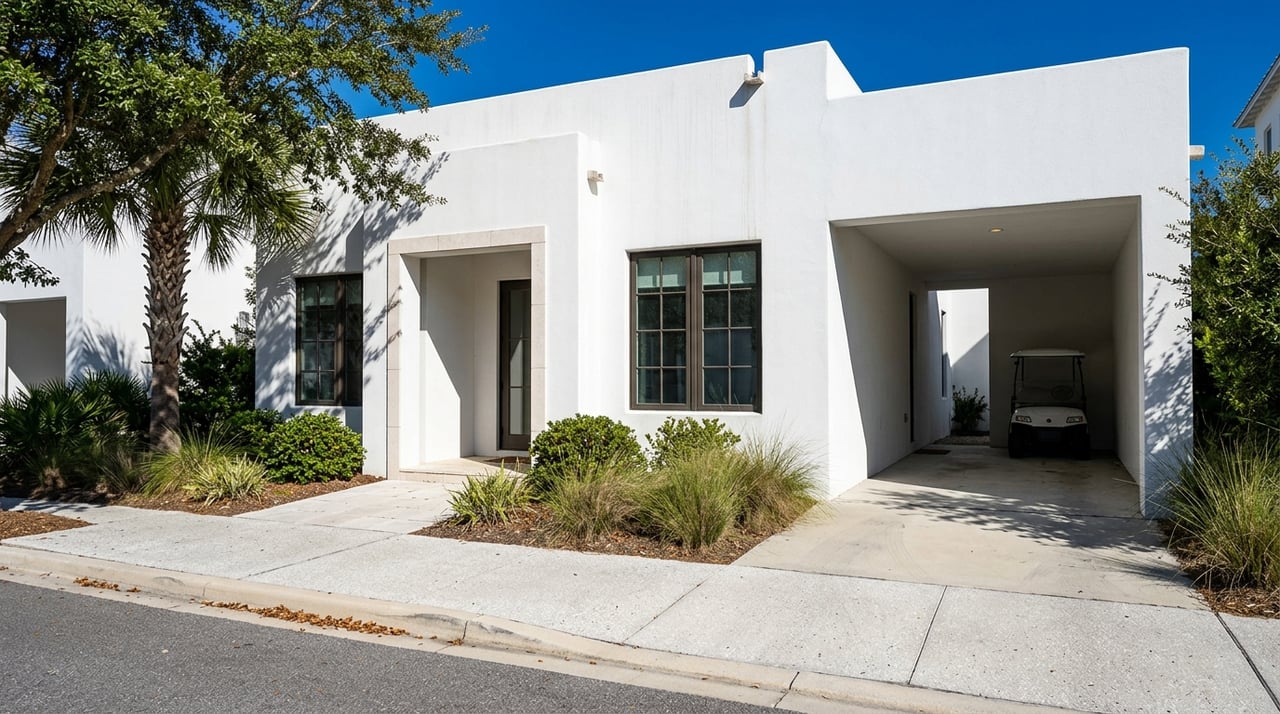
Golf carts and low-speed vehicles are part of the broader 30A lifestyle, but they come with rules. They can make short local trips easier, though they are not a complete substitute for a standard vehicle.
If you are considering a home in Watersound, it helps to think of golf carts and LSVs as useful additions to a car-light routine, not a guarantee of fully car-free living.
Florida golf cart rules matter
Under Florida law, golf carts may be operated only on designated county or municipal roadways. State law also says they are generally limited to use between sunrise and sunset unless specially equipped.
The law also sets operator requirements. Drivers under 18 must have a learner’s or driver’s license, and adults must carry government-issued photo identification.
LSV rules are more specific
For low-speed vehicles, Florida law limits operation to streets with posted speed limits of 35 mph or less. Walton County Sheriff’s Office guidance also notes that Walton County LSVs require a county safety sticker and are not allowed on Highway 98.
That last point is especially important. Since Watersound Town Center sits along the US 98 corridor, some trips may still require a standard car depending on the exact route.
What a car-light lifestyle looks like
For many buyers, the best way to think about WaterSound Beach is not fully car-free, but comfortably car-light. The community design supports short, local movement on foot or by bike, with golf carts or LSVs helping on approved routes.
That can create a slower, easier daily rhythm. You may walk to the beach, bike along the trail network, and save driving for trips that go beyond the immediate WaterSound and 30A area.
Best trips without a car
The most realistic non-car trips in and around WaterSound often include:
- Walking to neighborhood paths and beach access
- Biking along the Timpoochee Trail
- Moving between nearby neighborhoods and 30A destinations on connected multi-use paths
- Using a golf cart or LSV on approved local roads where allowed
These options work best for short distances and routine outings. They are part of what gives the area its easygoing coastal feel.
Where a car may still be useful
A standard car is still helpful for certain needs. Based on the area’s layout and local road rules, driving may remain the better option for:
- Trips that require Highway 98 access
- Longer errands beyond the immediate 30A corridor
- Routes that are not connected by paths or approved LSV roads
- Evening golf cart use unless the vehicle is specially equipped as allowed by law
For many homeowners, that balance is the sweet spot. You can enjoy less driving day to day without giving up flexibility when you need it.
Why this matters for buyers
Transportation shapes daily life more than many buyers expect. If you are comparing communities along 30A, understanding how easily you can walk, bike, or use a low-speed vehicle can help you decide whether a neighborhood fits the lifestyle you want.
In Watersound Bridges, the appeal is not just proximity to the coast. It is also the connected path network, beach-oriented layout, and access to the broader 30A trail system that support a more relaxed way to move through the day.
If you are looking for a home where beach access and local outings can feel simple and low-stress, this kind of mobility becomes a meaningful part of the value. It is one of the details that can shape how a property lives, not just how it looks on paper.
If you want help comparing Watersound Bridges with other 30A communities, the Geppert Beeker Group offers personalized guidance backed by deep local knowledge and a refined, service-first approach.
FAQs
Can you live in WaterSound Beach without a car?
- You may be able to handle many daily trips on foot or by bike, but the strongest takeaway from the available sources is that WaterSound is better described as car-light rather than fully car-free.
Is biking practical in Watersound?
- Yes. Watersound connects to multi-use paths and the approximately 19-mile Timpoochee Trail, which supports short trips between neighborhoods, beach areas, and nearby amenities.
Can you take a golf cart around WaterSound Beach?
- Golf carts can be useful on designated county or municipal roadways, but Florida law limits where and when they can operate, so they are not a universal option for every trip.
Are low-speed vehicles allowed near Watersound?
- Yes, in certain cases. Florida law allows LSVs on roads posted at 35 mph or less, and Walton County requires a county safety sticker. Walton County also notes that LSVs are not allowed on Highway 98.
Is WaterSound Town Center easy to reach without a car?
- Some access may be possible by walking or biking through connected paths depending on your starting point, but because the town center sits along the US 98 corridor, a standard car is the better choice.
What makes WaterSound Beach appealing for car-light living?
- The area’s shaded paths, multi-use trails, dune walkovers, beach boardwalks, and connection to the 30A trail network all support a more walkable and bike-friendly daily routine.